

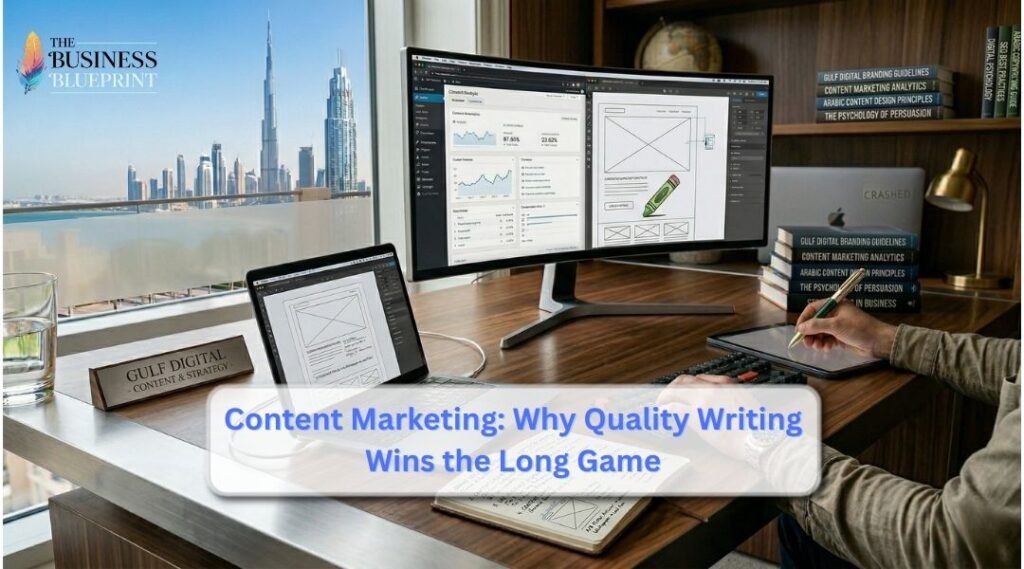
Content Marketing: Why Quality Writing Wins the Long Game
The “more is better” era of digital marketing didn’t just die; it choked on its own noise. If you’ve sat in a boardroom in Riyadh’s KAFD or a sleek office in Dubai’s DIFC lately, you’ve felt the shift. That frantic energy of 2020—where brands scrambled to post anything just to stay visible—is gone. It’s been replaced by a much grimmer realization: nobody is actually reading the fluff. We’ve spent years treating the internet like a bottomless pit that needed constant feeding, and now, we’re all just drowning in the resulting garbage.
By 2026, the GCC’s digital landscape has been hit by what I call “content gray goo.” It’s everywhere. It’s polite, it’s grammatically perfect, and it’s utterly, painfully forgettable. For a business leader here, the challenge has fundamentally shifted. You aren’t just competing with the rival across the street anymore. You’re competing with an infinite, free stream of “good enough” prose that costs nothing to produce. In this climate, high-quality writing isn’t some “extra” line item for the marketing budget. It is the only moat you have left.
The Tragic Myth of the Content Factory
We’ve all seen the wreckage of the volume-first strategy. A marketing director gets a mandate to “dominate search.” They hire a cut-rate agency or lean on a basic prompt to churn out forty articles a month. On the spreadsheet? It looks glorious. The keywords are checked off, the H2 tags are in place, and the meta-descriptions hit the character count to the digit.
But have you actually tried to read one of those pieces?
They feel like they were squeezed out of a tube of corporate toothpaste. They lack a pulse. When a potential client in Qatar or Kuwait lands on your site, they aren’t looking for a Wikipedia summary of a topic they already live and breathe. They want a solution to a high-stakes problem, a sharp regional perspective, or a reason to trust you with a multi-million dollar contract. If your writing feels robotic, they’ll bounce in a heartbeat. In a market as sophisticated as ours, “good enough” is a silent brand killer. Quality writing signals that you actually value the reader’s time. Because, let’s be honest: in 2026, time is the only asset that isn’t being devalued.
The Psychological Rhythm: Why We Keep Scrolling
Why can you devour a 3,000-word investigative piece in a premium journal but find yourself nodding off halfway through a 300-word “thought leadership” post on LinkedIn? It’s about the rhythm. Real human writing mimics a conversation. It breathes. It uses short, sharp sentences to drive a point home—like a hammer. Then, it expands into longer, more descriptive observations that allow the reader to catch their breath.
This “burstiness” is a psychological hook. It creates a tension and release that keeps the brain engaged. When you invest in a real writer, you aren’t just paying for the lack of typos. You’re paying for the ability to hold a human being’s attention in an era of infinite distraction. Most corporate blogs are written by people who were bored while they were writing them. If the writer is bored, the reader doesn’t stand a ghost of a chance. You can’t automate the “spark” that makes a reader stop and say, “Wait, I never thought of it that way.”
Trust is the Only Currency That Scales
Let’s look at the metrics that actually show up in your bank account. Marketing teams love to obsess over vanity numbers—impressions, clicks, and “reach.” But you can’t pay your staff with a “thumbs up” emoji. The only metric that correlates with long-term revenue is trust.
High-quality writing builds that trust by demonstrating expertise without having to scream about it. It’s the difference between a pushy salesperson at a trade show and a mentor giving you invaluable advice over a cup of gahwa. When your content is well-researched, eloquently argued, and genuinely helpful, you stop being a “vendor” and you start being an “authority.” Think about your last major business decision. Did you go with the firm that spammed you with generic listicles, or the one that published a deep-dive white paper so insightful it shifted your entire quarterly strategy? That is the power of quality. It does the heavy lifting of the sales cycle before a human salesperson even picks up the phone.
The AI Paradox: Why Robots Make You More Valuable
There’s an elephant in the room, and it’s made of silicon. Yes, AI can write. It can write fast, and it can write for next to nothing. But here’s the paradox: as the world becomes saturated with AI-generated text, the value of a distinct, human voice has actually skyrocketed.
Think of it like handmade furniture. When mass production first hit the market, everyone marveled at the efficiency. But today, a hand-carved oak table is worth twenty times more than a flat-pack desk. Why? Because it has character. It has a story. It has the fingerprints of a creator on it. Quality writing in 2026 isn’t about being “perfect.” It’s about being particular. It’s about sharing an anecdote from a failed project in Neom or a hard-won lesson from a startup launch in Bahrain that a machine could never experience. If your content sounds like everyone else’s, you’re basically training your customers to ignore you.
SEO is No Longer a Bot Game
If you’re still writing primarily for search crawlers, you’re playing a game that ended years ago. Search engines have gotten smarter. They now prioritize “user signals” like dwell time and repeat visits over keyword density. Their goal is to satisfy the human, not the index.
Quality writing naturally solves for SEO. When you write deeply and intelligently about a subject, you include the semantic keywords that search engines love without even trying. More importantly, you keep people on the page. You turn a “visitor” into a “reader,” and eventually, into a “client.” This isn’t just about pleasing an algorithm; it’s about building a digital ecosystem that rewards depth over surface-level fluff. If your content is so good that people actually bookmark it, Google will find you.
The Long Game: Compounding Returns
Content marketing is a marathon, not a sprint. A poorly written post has a shelf life of about 48 hours before it vanishes into the digital abyss. A high-quality, authoritative piece of “pillar content” can drive leads for years. I’ve seen articles written four or five years ago that still rank on the first page of search results and still generate inbound inquiries every single month. That is a high-ROI asset.
You pay for the quality once, and it pays you back indefinitely. In the GCC’s rapidly evolving economy—where we are moving from oil-dependency to knowledge-led industries—your digital footprint is your most valuable real estate. Are you building a skyscraper or a tent? Skyscraper content requires a foundation of research and the finishing touch of expert prose. It takes longer to build, but it survives the storm.
Final Reflections
At the end of the day, content marketing isn’t about filling space; it’s about filling minds. We’ve hit a point where people can tell within three seconds if they’re reading a soul-less script or a genuine insight. As we move deeper into a decade defined by digital saturation, the brands that thrive will be those that treat their words with the same respect they treat their products. If you aren’t willing to write something worth reading, why on earth should anyone be willing to buy what you’re selling? The long game is won by the patient, the insightful, and the articulate. Choose your words like they’re the only ones you’ll ever get to say. In this region, reputation is everything—don’t trade yours for a few cheap clicks.
FAQs
Why does quality beat quantity in the GCC?
Because high-value decision-makers in the region prioritize personal trust. They want to see that you understand the local landscape, not just a global template.
Can I use AI and still produce quality writing?
Use AI for the heavy lifting of research or outlining. But for the final output? A human needs to inject the nuance and regional experience that machines lack.
How do I justify the cost of an expert writer?
One high-quality piece can generate leads for years. Compare that ROI to the cost of a hundred cheap posts that nobody ever reads.
Is long-form content dead for busy executives?
No. Executives don’t hate long content; they hate boring content. If you solve a critical business problem, they will make the time to read every word.
How often should a brand publish?
Quality is the only consistency that matters. It’s far better to publish one masterclass article a month than a piece of fluff every Tuesday.
What exactly is “Content Gray Goo”?
It’s the mass of repetitive, unoriginal AI-generated text that offers no new value, causing audiences to tune out your brand completely.
How do I find a unique brand voice?
Stop trying to sound “professional” and start trying to sound useful. Use real stories, admit to failures, and share specific regional insights.
Meta Tag:
In 2026, “more” is no longer better. Discover why high-quality, human-led writing is the only way to build real authority and win the long game in the GCC.